


In Gabon, surfing hippos, gorilla trekking, elephant safaris, and untouched rainforests could kick-start tourism in this little-known West African destination.
“Let’s see what Mother Nature has in store for us today,” Ghislain Bouassa said with a grin as we set off on a muddy rainforest trail shadowed by tall Okoume trees wrapped in thick, creeping vines.
With years of experience guiding in Pongara National Park—a vast protected area of rainforest, mangroves, and beaches overlooking the Atlantic Ocean in Gabon— Bouassa soon brought the safari buggy to a deft halt after spying the deep footprint of an elephant pressed into the mud. Motioning for quiet, his carefully placed footsteps led us through the thick forest until we emerged into the bright sunlight of the open savannah where a one-tusked elephant foraged amongst the tree line less than a hundred meters away.
Gabon, a little-visited West African country bordered by the Republic of Congo, Cameroon, and Equatorial Guinea, is home to an estimated 95,000 critically endangered forest elephants, amounting to some 80 percent of Africa’s forest elephant population. With a staggering 88 percent of the country covered in rainforest, Gabon is also home to around 35,000 lowland gorillas, huge troupes of mandrills (the world’s largest monkey species), and large herds of forest buffalo.


Recommended Fodor’s Video
And with its offshore oil reserves fast running out, Gabon—a stable country in a region infamous for its volatility—hopes that ecotourism can kick-start a nature-based economy that protects this biodiversity from further destruction.
Gabon: The Last Eden
“We want to stop oil, gas, and mineral extraction, and we want to diversify into tourism,” explained Christian Mbina, the General Director of Agatours, the government agency tasked with developing tourism. “This is our opportunity to create a new Gabon with a new vision.”

With the 3rd highest GDP per capita in Africa, Gabon has traditionally relied on fossil fuel extraction and other exploitative industries like logging. But with only 2.3 million people living in a country covering an area of 100,000 square miles, Gabon’s rainforests ensure it’s also one of the world’s only carbon-negative countries.
In 2002, the government recognized this impressive biodiversity by creating 13 national parks covering 11 percent of the country’s land mass. Twenty years later, Gabon sees itself as an African Costa Rica, with ambitions to become an African leader in conservation and a catchy new tourism drive that’s selling the destination as the “Last Eden.”
“We call our country the “Last Eden” because we have things you can’t find anywhere else,” said Mbina. “Like orange crocodiles and surfing hippos.”
How Tourism Can Shift Gabon’s Economy
“When you go into the forest, the sea is always behind you in Gabon,” said Bouassa as we were enveloped by the dark shade of Pongara National Park. “That means when you leave the forest, the sea is in front of you. You find your way by listening to the sea.”
Located a short boat ride across the Gabon Estuary from Libreville, the Gabonese capital has only a few hotels, a solitary safari lodge, and a lighthouse designed by Gustave Eiffel from when Gabon was a French colony.
Bouassa’s navigation tricks work well in Pongara National Park, where the forest grows right up to the beaches, and we were soon hiking on white sand towards a flock of egrets that surrounded two buffalo lazing in the Atlantic surf.
“The buffalo would never have come so close in the past, but now they know we won’t hurt them,” said Bouassa. He continued to explain how in Pongara National Park, guides and rangers have been habituating the wildlife to humans and running anti-poaching programs in surrounding villages.
It’s a tough job, given that animals suffer from poaching that’s either driven by hunger or the lucrative trade in bush meat, but Bouassa said they’re starting to see results as more opportunities open up for rural Gabonese to work in tourism.
The potential for tourism to provide economic opportunities is huge in Gabon. This same coastline is also the nesting ground of a large population of leatherback turtles, and between June and July, migratory whales can be seen from the shore. Further south, in Loango National Park, where tourists can book gorilla treks at a fraction of the cost of those in Rwanda or Uganda, the beaches are the stomping ground of curious hippos known to enjoy surfing on the ocean waves.
Tourism is just one part of the plan to replace oil revenues with an economy that can protect nature. In December 2022, Gabon announced an ambitious new plan to sell “carbon credits.” The controversial scheme allows countries and multinational companies to offset their own carbon emissions by buying these credits.
Gabon will then invest this money into protecting its rainforests and wildlife, which drives demand for tourism, creates more jobs in tourism and conservation, and contributes to the wider vision of a nature-based economy that’s not reliant on oil revenue.
Learning to Prioritize Conservation
Stand on the same beaches, though, and you can see cargo ships departing from Libreville’s harbor. In Port Gentil, the gateway to Loango National Park in the south, oil refineries burn on the same shores where eco-retreats entertain tourists.
The hotels I visited during my week-long stay in Gabon had yet to employ basic tenets of sustainable tourism, with single-use plastics ever-present and a lack of sustainable waste removal or processing systems apparent.
One safari lodge was proud of its caged crocodile, there were no systems in place to protect turtles on nesting beaches, and a sanctuary had been forced to keep two gorillas in caged quarantine for two years due to a lack of funding.
The contrasts between Gabon’s ambitious ecotourism vision and the realities on the ground are often stark, but it’s no easy task attempting to reconcile the multitude of challenges faced by the country.
“The people in Gabon are beginning to see the value of conservation. They appreciate nature and realize how impressive it is to have 88 percent forest cover,” said Clyde Onaga, who works for the national park’s authority in Gabon. “But there’s a huge conflict with people and the environment. Mainly, with the elephants.”
The declining availability of fruit in elephant habitats, which Onanga said was driven by a warmer, drier climate resulting from climate change, forces forest elephants to encroach on farms, villages, towns, and even cities, often with deadly consequences for either the elephant or people.
People vs. Elephants
After two days of hiking and safaris in Pongara National Park, a boat ride along the Gabon Estuary brought me through dense, carbon-guzzling mangroves that hide hippos and dwarf crocodiles to the Nyonié Reserve, where Lionel Ndong explained how his home village abandoned agriculture two decades ago because of the danger of rampaging elephants. Ndong highlights the difficulties at the heart of these human-wildlife conflicts.
“Sometimes I think the government cares more about animals than about people,” he told me. The government says the elephants are vital because they help spread the forest. But when the elephants are the ones destroying human life, we aren’t allowed to stop them.”
Since 2016, the Gabonese government has been installing innovative electric fences to stop elephants from destroying crops. In 2022, they pledged to step the scheme up after successful trials, although Ndong isn’t holding out hope. He told me his village had been asking the government for electric fences for at least seven years, to no avail.
The elephants are the source of problems, but perhaps paradoxically, they are also a potential solution. The potential for tourism balances Ndong’s view of the elephants because he now works as a tour guide, often leading tourists on elephant treks in the Nyonié Reserve.
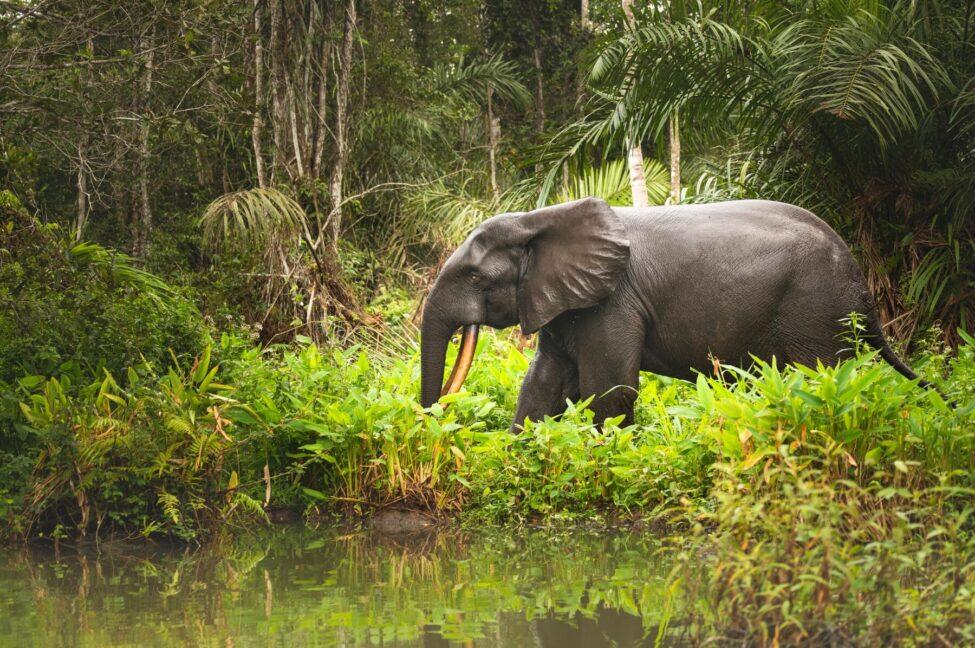
“More elephants mean more tourists,” he said. “And that allows me to earn some money and stay in my village. I’m fascinated by these animals, too. Every time I see a different elephant, I see something new. It makes me happy when I guide tourists and they see these elephants for the first time. I share their joy.”
Ndong explained how the local safari resort provides jobs for chefs, guides, and cleaners – something they’d love more of – but a French ex-pat owns the business. There’s been little government interest in establishing community-based tourism projects that would give people like Ndong a larger stake in both conservation and tourism.
A cynical commentator might also point out that cronyism is rife in Gabon. Ali Bongo, the President of Gabon, has a house within the boundaries of Pongara National Park, business owners in Libreville are switching oil money for tourism money, and the underlying motives behind conservation often appear to be financial.
Coming from the United Kingdom, one of the most nature-depleted countries on the planet, this isn’t something I’m in a unique position to judge, though. We destroyed our nature long ago. As one Gabonese government worker told me, the rainforest is a resource, and they need to monetize it to save it.
Gabon has the potential to be a fascinating safari destination, and it’s the tour guides on the ground – like Ndong and Bouassa, who are intertwined with the environment they’re part of–who will ultimately be the ones to drive ecotourism forward in their country.
“Stop and listen,” Bouassa had said while walking in the forest. “You could be five meters away from an elephant, and you’d never know. You need to slow down to connect yourself to the jungle. Don’t just walk, but appreciate every step. As Africans, especially as Gabonese, we are deeply connected with nature. We have to learn as a modern society how to treat nature and connect with nature.”