


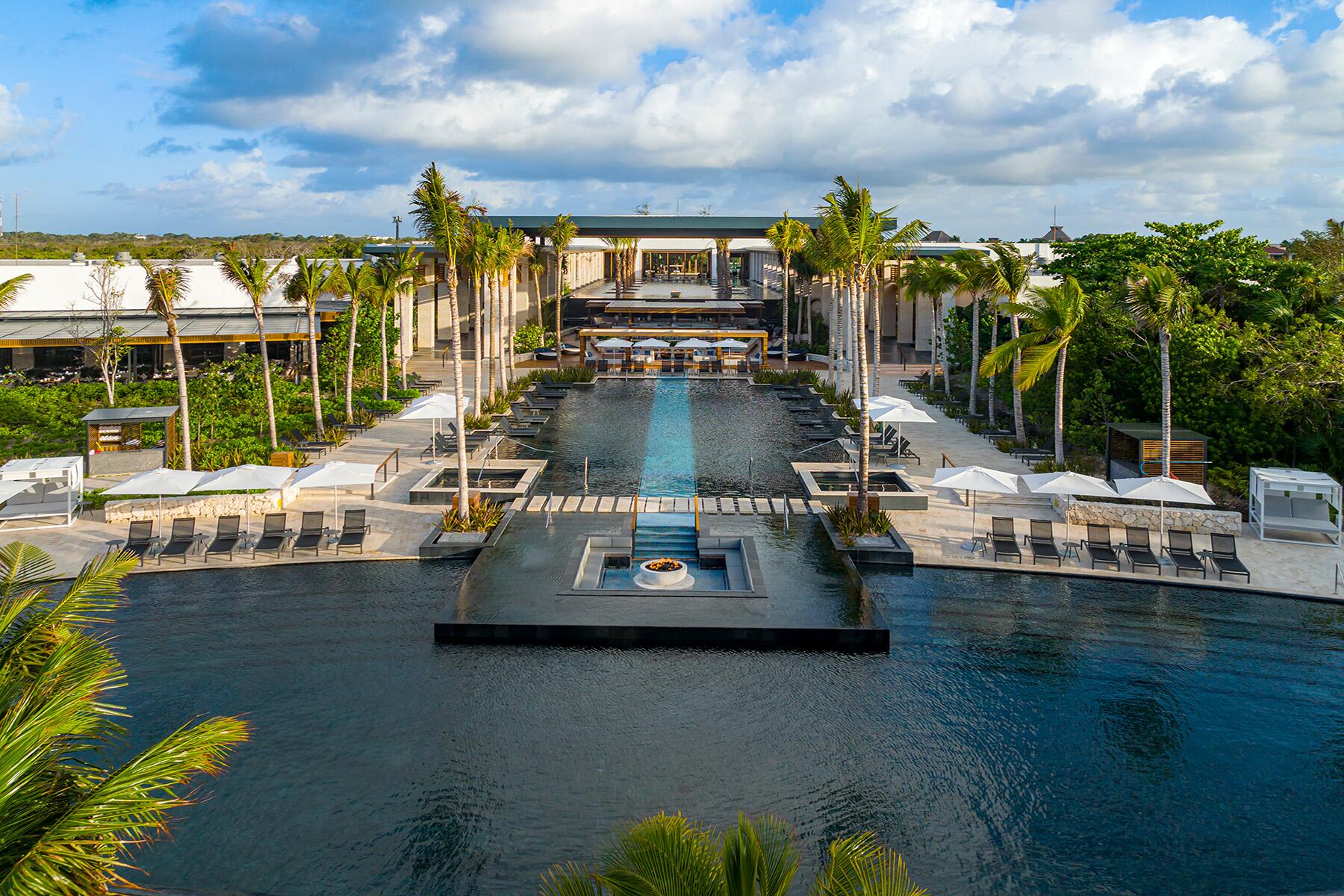

At Conrad Tulum Riviera Maya, wellness is inspired by the Yucatán’s sacred cenotes and Mayan architecture.
Arriving in Quintana Roo’s Conrad Tulum Riviera Maya, travelers enter through towering wooden doors in an open-air lobby that combines the elements of earth, air, and water. A polished stone floor extends to a colossal center pool, while intricate wooden slats adorn the 30-plus-foot vaulted ceiling. Monumental is a word that not only describes the design of this new five-star resort, but also the architecture of the ancient Maya people, whose intricate structures have rivaled those of the Pyramids of Giza and beyond.
It’s not only the reinterpretation of Mayan architecture that makes the hotel stand out, but also the large-scale design that seamlessly integrates the native jungle landscape, populated with mangroves, fronds, and wildlife. It’s still luxury at every turn, and although this immersion in nature is intentional, these subtle nods to Indigenous designs echo the essence of the land. The on-site spa, for instance, is a space where ancestral healing practices are integrated into the wellness experience and also connect back to the land. And of course, the design mirrors that sentiment.
For instance, one of the most prominent ecological features of the Yucatán region is its cenotes. Formed over 66 million years ago by a meteorite (the one most likely to have swept out the dinosaurs), these underground freshwater pools permeate the region, with over 7,000 cenotes and counting. These natural wonders held deep spiritual significance for the ancient Maya, as they were used in ritual sites and provided access to fresh drinking water that helped sustain communities.
While travelers in Quintana Roo’s Riviera Maya can explore cenotes through group tours, solo trips, and even deep diving or cave exploration, the truth is, those experiences aren’t for everyone (especially the less-adventure-minded traveler). Since many cenotes were ritual sites, some of which included human sacrifice, they hold tremendous spiritual power. They are best approached with a sense of respect and reverence for the land’s heritage and spirits. Conrad Tulum’s onsite spa pays homage to the geological features of Yucatán’s cenotes, just without extreme depths of dark water, bats, and lingering spirits (perhaps).
Upon entering the airy entrance, you’re led to a dome-like structure vaguely reminiscent of a temazcal (a stone sweat lodge). This is the central area of the spa, marked by a large, circular open-air portal to the sky, outlined by a thatched bamboo canopy. Mirroring the sky overhead, a small fountain pool sits directly below the sky portal, as the faint sound of bubbling water permeates the space, rather than your typical, run-of-the-mill spa music. Here, the natural surroundings serve as the primary soundscape.
Sunbeams mark the stone walls of the circular space with shadows at different times of day, similar to the experience of visiting a semi-enclosed cenote. At noon, the sun is directly overhead, reflecting the fountain, but the half-moon sunbeams slowly travel the room throughout the day, marking time and creating a natural ambiance rarely seen in contemporary spas.
On the walls, trellises of foliage cascade towards the dark stone floor, like tree roots at the edge of cenotes reaching down, adorning the cave enclosure in their pull towards the water. Within this area, guests can glide between a vapor steam room (lightly scented with eucalyptus), a traditional hot sauna, a cold plunge, and a hot bath. Outside the central dome-shaped area, a winding path carved through the jungle leads guests to a larger “cenote” pool, complete with water jets designed to target specific areas of the body. In truth, one could stay under these jets for long stretches of time, not only for hydrotherapy, but also as a soul-nourishing meditation.
This space is mildly reminiscent of an enclosed or cave-like cenote, with a towering thatched-like roof, but it’s still open-air, so sunlight drizzles in at every angle, offering views of the surrounding jungle and the natural soundscape of birds, wind, and water movement. It feels like a natural pool, especially with the occasional drifting leaf or twig — just without any fish, creepy crawlers, or potential dread of the bottomless abyss below that can sometimes accompany visiting an actual cenote.
Off to one side, a meditation area awaits with several cushions, a large conch shell, and small musical instruments. And across the pool, an outdoor Juice Bar serves up aqua frescas, elixirs, coffee, and teas, which are included in the 1,500 MX peso (roughly $150 USD) fee to access the spa facilities. Travelers can also book one (or more) of the 16 separate spa treatments, each based on ancestral healing. The treatments are further anchored in the Four Directions of Wellness, drawn from Mayan cosmology (East/Renewal, West/Release, North/Clarity, South/Balance). It’s this nod to the ancestral healing lineages and mystical energy of the Riviera Maya that makes the experience more than just another spa.
These nods to the land’s heritage continue throughout the resort. At Autor, an onsite restaurant with a Michelin nod, each dish tells the story of Mexico’s rich culinary history, with flavors inspired by Peruvian and Chinese influence, as well as the micro-diversity across Yucatan, Oaxaca, San Pedro Actopan, and the banquets of Moctezuma. Even the garlic-infused butter pads are tiny dinosaurs, reminiscent of the original inhabitants of the land millions and millions of years ago.
And before you leave paradise, be sure to stop by the Casitas Aluxes — tiny stone houses meant to honor the mischievous little guardian spirits of the land — and leave a little offering. A flower will do, or a shiny trinket, to give thanks for the journey.