


Trip Report: Peru, Part 1 — Ancient Lima (plus some practical comments)
Due to health issues that probably had more to do with the crowded planes and airports I endured on the way to Peru, than with the country itself, I have only about eight full travels days to report on — not usually enough for a large and fascinating country like Peru, but as I’ll be covering a couple of places that most tourists overlook — Lima, and Ayacucho (which I will describe soon in a separate trip report) — perhaps this condensed report is worth posting all the same. I will concentrate on places I managed to visit on this short trip, but I will occasionally mention, only as suggestions for further research, places I have seen on past trips but did not manage to see this time.
What follows is not a comprehensive guide to the great city of Lima, but an introduction to a couple apsects of Lima that I believe many tourists overlook: Ancient Lima, and the Historic Center (to appear very soon as a separate report). Lima cannot compete easily with Peru’s many other wonders, and I understand that those on shorter trips may be reluctant to sacrifice time in Peru’s many great destinations in favor of the capital. And I know that unlike, say, Paris or San Francisco, Lima is not one of those cities that people seem to fall in love with at first sight, though I’ve found that it’s worth getting to know — and as I have no conceits about being unique, I’ll assume there are others like me who will come to appreciate Lima once they’ve dived in.
The narrative below will by followed by photos, if I can figure out how to get them in. Updates and corrections (if intended only to be helpful) will be welcome among the responses.
ANCIENT LIMA
There are several ancient sites within metropolitan Lima that you can visit. All of them pre-date Machu Picchu, in some cases by at least eight centuries, though as they are mostly adobe structures, often eroded, they may not present quite the same visual spectacle as the stone structures of Machu Picchu in their amazing mountain setting. Still, for those with an interest in these things, the Lima sites are well worth visiting, and you probably won’t have to share them with tourist crowds, or bother with advance ticket purchases.
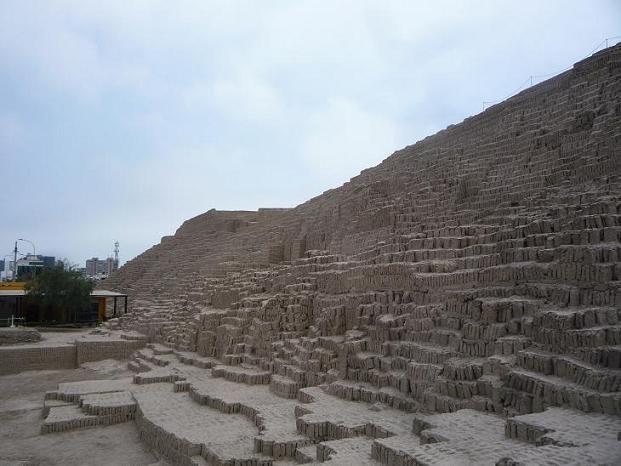
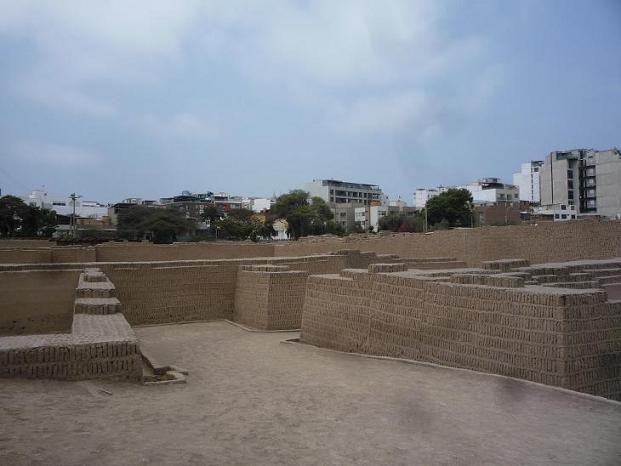
The best-restored and most easily accessible of the ancient Lima sites, sitting right in the middle of the popular Miraflores municipality where most tourists stay, is Huaca Pucllana. In Peru, expect to encounter ”huaca” a lot (pronounced, and sometimes spelled, “waka”). This Quechua word is hard to pin down; approximately, it means “sacred” or “special” place, but that can be almost anything. At one extreme a huaca can be a small, personal shrine in your home — on one of my Peru trips, a hotel owner showed be one such huaca in one of his rooms. (I was allowed only a glimpse, as there were a couple of guys worshipping beside it.) Then again, a huaca can be a giant boulder or mountain-top, or even a personage from Peruvian myth or legend. But today, the word usually refers to any of the huge, ancient adobe structures left by the pre-Inca civilizations of Peru’s coast — structures which probably were not “sacred” to the original builders, but only to the amazed Incas who later stumbled upon them.
You can easily walk to to Huaca Pucllana (“puk-YA-na”) from anywhere in central Miraflores. Originally built by the prosaically-named Lima culture, Huaca Pucllana probably reached its peak between the 6th and 8th centuries CE, then went into decline before being restored by the Ychsma culture in the eleventh. You can go through the site only on a guided tour, but the tour is included in the modest ticket price, and as the tour guides are staff members, tours in both Spanish and English go on continually during opening hours. From any of the higher points of Huaca Pucllana, the sight of the impressive ancient city spreading out just before you, framed by the elegant high-rises of modern Miraflores in the distance, makes for both a memorable and a rather unusual visual experience.
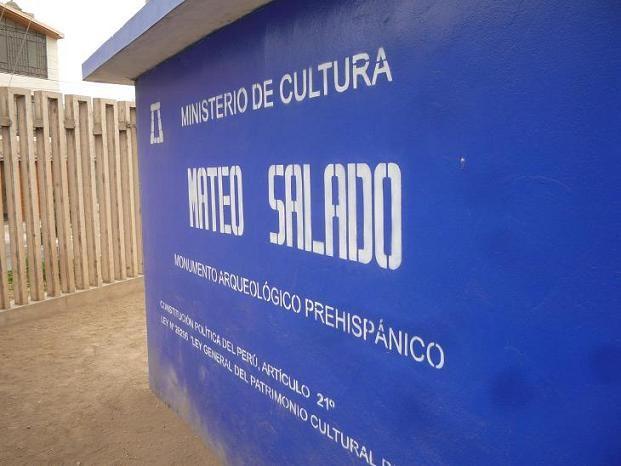
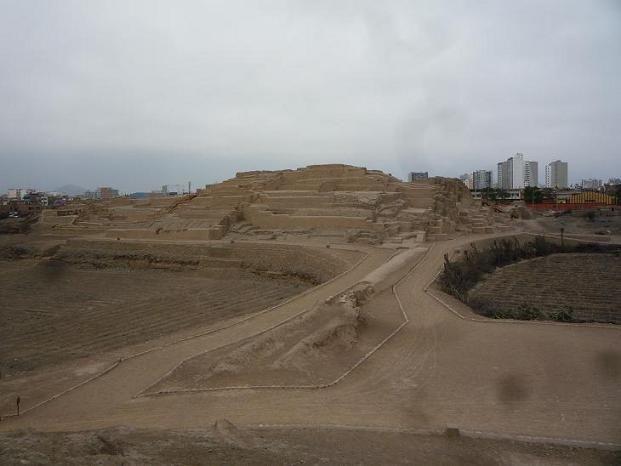
On this trip I also visited the Mateo Salado archaeological complex, which is located at the edge of the Pueblo Libre municipality, just off the large, circular and basically empty Plaza de la Bandera. The ancient sandy-brown huacas, as seen from across the huge spare plaza, make for a rather weird site as you approach. The inconspicuous site entrance is on Mariano H. Cornejo avenue, a little west of the plaza.
The site was named after Matheus Saladé, a French Lutheran of the 16th century who implausibly emigrated to Spanish Lima and lived as a hermit among the huacas, from where he was eventually picked up and executed by the Inquisition. This huge site — at least as large as Huaca Pucllana, if not larger, and opened to the public only about ten years ago — comprises four truncated pyramids (a fifth, “pyramid D,” is not yet open to the public), interspersed with plazas. It reached its peak under the Yschma, from the 12th century CE until the arrival in the Incas.
I don’t know whether this is typical, but at the time of my visit there was no one else except the staff members and a trio of Peruvian visitors; for most of my visit I practically had this huge site to myself. Indeed, one of the things I’ve come to love about Peru across 20 years of visits, is that beyond the Sacred Valley and a few other high-level tourist sites, there are many fascinating places in this vast country where you can still feel more like a real traveller, rather than like another cipher in the daily crowd of consumers to be serviced.
You can walk through this site on your own — in fact at the time of my visit that was the only option. Of course you need to stay within the designated walkway; and if it’s a sunny day, you’ll probably want to be wearing a hat. There are rest rooms just inside the entrance.
I should add that those who find the ancient sites of Lima interesting may want to consider visiting similar archaeological sites further up the coast. Examples: In and around Trujillo there are at least three huaca sites — Sol and Luna, Arco Iris, and Esmeralda, as well as the grand site of Chan Chan; and farther north in the Lambayeque Department (i.e., province) you’ll find the Sipán, Tucume, and Batan Grande archaeological sites, as well as three fine museums: the Sicán Museum in Ferrañafe; and the Hans Brüning and, more famously, the Royal Tombs of Sipán museums, both in the town of Lambayeque. And perhaps even more, since my visit way back in 2007. (Notes: Sipán and Sicán are not the same; and the Royal Tombs of Sipán Museum is, as stated, in the town of Lambayeque, not at Sipán.)
ADDITIONAL IDEAS AND SUGGESTIONS
An approximately 20-minute walk, mostly along San Martín Avenue, separates the Mateo Salado complex from the National Museum of Anthropology, Archaeology and History in the Pueblo Libre municipality (which is also home to the celebrated Rafael Larco Museum). The median strip along one stretch of San Martin, and called the Boulevard de las Patricias (women patriots), presents memorials to several heroines of the two great rebellions of the late colonial period, the Tupac Amaru II revolt of the 1780s, and the Independence wars of the 1820s; plaques (in Spanish) give brief biographies of these women, and describe the mostly unfortunate fates they met.
At the time of my visit the National Museum was closed, apart from a portion of the History section dedicated to the independence period. However, I think the closing was only temporary; if you’re considering a Lima visit keep looking for updates on the internet. And if you do make it to the museum, don’t overlook the unusual statue of the great liberator, Simón Bolívar, in the adjacent plaza. Also if you’re interested in traditional Peruvian criollo, or “creole,” music — not many of you, I suppose — check out the short, pedestrianized street near the museum dedicated to the celebrated composers and performers in this genre.
As I mentioned above, some health issues interrupted my attempt to duplicate a Lima visit I made nine yerars ago, which I devoted to checking out Lima’s various ancient sites; and on this trip I made it only to the two sites described above. But those with an interest in ancient Lima should check out the following, all of which I have seen on prior visits:
Huaca Huallamarca (“wa-ya-MAR-ka”). This is a nicely restored ancient pyramid in the middle of the upscale San Isidro neighborhood. If your taxi driver can’t find it (remarkably, neither driver on my two past visits was able to), just get off where El Rosario Avenue meets the northern edge of the golf course, and walk a couple of blocks north.— you’ll soon see the large brown pyramid looming ahead, looking totally out of place in this elegant neighborhood.
The San Miguel municipality. This seems to be huaca-central in Lima, with ancient structures scattered all around, several in the Park of Legends. There is also a huaca on the campus of the San Miguel university (the modern campus, not the original one in the historic center), which must be convenient for the archaeology department. From that 2015 trip I also recall spotting a huaca sitting in a small park next to some tennis courts. And if it’s open to the public (but I don’t think it is), the El Potosí site should be worth visiting; on my 2015 trip, it looked pretty impressive based on what I could see gazing through the fence.
Pachacamac. At the southern extremity of metropolitan Lima, this is the most extensive of the local ancient sites, and makes for a proper day trip, which any of several tour agencies in Lima can arrange. Though it will be a little more expensive, you may want to consider hiring a reliable taxi driver through your hotel for a trip to, through, and back from the site.
Though these ancient sites are now scattered around Lima, one can imagine what a sophisticated civilization must have thrived here at the peak of the Yschma culture about a thousand years ago. If these various ancient sites, from Mateo Salado down to Pachacamac, were then part of one grand urban center, it must have been as great a metropolis, in its own way, as Lima is today.
Addendum #1: Some practicalities (information based on my experience as of early November 2024):
Getting around: Lima now boasts a modern metro system, the “Metropolitano,” which, though not comprehensive, does connect the three areas that most tourists spend their time in: the historic center, Miraflores, and Barranco. The vehicles are actually electric buses, but their routes lie mostly along dedicated “bus-ways”; they come and go frequently; and overall the Metropolitana has the feel of a typical European metro system. (The “C” buses are probably the ones that you will use the most.) Note, though, that the Metropolitano can get very crowded at times.
The airport: The Jorge Chavez International Airport (named after a real aviation pioneer, not a president or politician), is located to the NW of central Lima in the Callao municipality. The surrounding neighborhood is rather drab, though the airport is safe; but there are only two proper airport hotels that most tourists would want to stay in, the Wyndham/Costa del Sol, and the Holiday Inn. If you need to lodge near the airport, make your reservation as soon as you can.
Between the airport and the city: The standard taxi fare between the airport and Miraflores is currently around 65 soles, approximately $18 (US). Do not walk outside of the terminal and into the waiting crowd of taxi drivers — your luggage will promptly be whisked away to a taxi of unknown provenance before you know what’s happened. Rather, use one of two resources: (1) the website taxidatum, which I haven’t used yet but which seems to get great reviews, or (2) the taxi desk (“Green Taxi”) inside the terminal just beyond baggage claim; I’ve always found their service to be prompt and reliable.
You may also want to look into the Airport Express bus (www.airportexpresslima.com), which I used on my most recent two trips and found to be excellent. From Miraflores to the airport (and of course in the opposite direction), they leave hourly from around 7:00am (more or less, depending on which of the four Miraflores pick-up locations you board from) to 9:00pm; the standard cost is currently 20 soles, about $5.50, though during my most recent visit they were offering a special rate of only 15 soles.
Got your soles? Note that there is at least one currency exchange desk in the airport in baggage-claim, and maybe another near the terminal exit.
Got your Machu Picchu Tickets? The Tourist Information office in central Miraflores, at the SW corner of Kennedy Park, has a notice board announcing “last minute” Machu Picchu tickets — but of course only when some are available. If somehow you find yourself in Lima without your tickets, try checking that location, though of course there’s no guarantee on any given day that last-minute tickets will be available.
Addendum #2: Names and dates
Throughout Lima, and Peru generally, several dates and names appear frequently on streets, parks, and monuments. For the curious, here is a short list of the ones you will encounter most frequently:
Simón BOLIVAR, Antonio José de SUCRE , José de SAN MARTIN: The three Great Liberators who freed Peru, and South America, from Spain between 1810 and 1824. (The first two were Venezuelan, the third Argentine.)
28 Julio (July): The date on which, in 1821, San Martín proclaimed Peruvian independence in Lima. (Actually, San Martín had already proclaimed Peruvian independence several months earlier in the small town of Huaura, about 90 miles up the coast, but I guess it didn’t quite count untill he had proclaimed it in Lima.)
Dos de Mayo (2nd May): The day in 1866 on which Peru won a decisive naval victory against Spain at Callao, the port of Lima. (This was not the independence war, which had ended in Peru’s favor 42 years earlier; rather, this was one of those odd little wars that the European powers kept launching against the American republics, usually to collect debts.)
7 Junio (7th June): The name of the central park of Miraflores, the Lima municipality where most tourists stay. On this date in 1880, the outnumbered Peruvians fought a heroic but unsuccessful battle against the Chileans at Arica (now in northern Chile).
Francisco BOLOGNESI: Commander of the Peruvian forces at the Battle of Arica, who died in action on 7 July after responding to the the Chileans’ demand for a surrender with the promise that he would “fight until the last cartrige has been fired.”
Miguel GRAU: The war with Chile (1879-1883) was basically a big calamity for Peru and its ally Bolivia, but early in the war Admiral Grau won some stunning naval victories for Peru. He is known as the Gentleman of the Seas (Caballero de los Mares) for having rescued the sailors from the Chilean ships he sank.
Due to health issues that probably had more to do with the crowded planes and airports I endured on the way to Peru, than with the country itself, I have only about eight full travels days to report on — not usually enough for a large and fascinating country like Peru, but as I’ll be covering a couple of places that most tourists overlook — Lima, and Ayacucho (which I will describe soon in a separate trip report) — perhaps this condensed report is worth posting all the same. I will concentrate on places I managed to visit on this short trip, but I will occasionally mention, only as suggestions for further research, places I have seen on past trips but did not manage to see this time.
What follows is not a comprehensive guide to the great city of Lima, but an introduction to a couple apsects of Lima that I believe many tourists overlook: Ancient Lima, and the Historic Center (to appear very soon as a separate report). Lima cannot compete easily with Peru’s many other wonders, and I understand that those on shorter trips may be reluctant to sacrifice time in Peru’s many great destinations in favor of the capital. And I know that unlike, say, Paris or San Francisco, Lima is not one of those cities that people seem to fall in love with at first sight, though I’ve found that it’s worth getting to know — and as I have no conceits about being unique, I’ll assume there are others like me who will come to appreciate Lima once they’ve dived in.
The narrative below will by followed by photos, if I can figure out how to get them in. Updates and corrections (if intended only to be helpful) will be welcome among the responses.
ANCIENT LIMA
There are several ancient sites within metropolitan Lima that you can visit. All of them pre-date Machu Picchu, in some cases by at least eight centuries, though as they are mostly adobe structures, often eroded, they may not present quite the same visual spectacle as the stone structures of Machu Picchu in their amazing mountain setting. Still, for those with an interest in these things, the Lima sites are well worth visiting, and you probably won’t have to share them with tourist crowds, or bother with advance ticket purchases.
The best-restored and most easily accessible of the ancient Lima sites, sitting right in the middle of the popular Miraflores municipality where most tourists stay, is Huaca Pucllana. In Peru, expect to encounter ”huaca” a lot (pronounced, and sometimes spelled, “waka”). This Quechua word is hard to pin down; approximately, it means “sacred” or “special” place, but that can be almost anything. At one extreme a huaca can be a small, personal shrine in your home — on one of my Peru trips, a hotel owner showed be one such huaca in one of his rooms. (I was allowed only a glimpse, as there were a couple of guys worshipping beside it.) Then again, a huaca can be a giant boulder or mountain-top, or even a personage from Peruvian myth or legend. But today, the word usually refers to any of the huge, ancient adobe structures left by the pre-Inca civilizations of Peru’s coast — structures which probably were not “sacred” to the original builders, but only to the amazed Incas who later stumbled upon them.
You can easily walk to to Huaca Pucllana (“puk-YA-na”) from anywhere in central Miraflores. Originally built by the prosaically-named Lima culture, Huaca Pucllana probably reached its peak between the 6th and 8th centuries CE, then went into decline before being restored by the Ychsma culture in the eleventh. You can go through the site only on a guided tour, but the tour is included in the modest ticket price, and as the tour guides are staff members, tours in both Spanish and English go on continually during opening hours. From any of the higher points of Huaca Pucllana, the sight of the impressive ancient city spreading out just before you, framed by the elegant high-rises of modern Miraflores in the distance, makes for both a memorable and a rather unusual visual experience.
On this trip I also visited the Mateo Salado archaeological complex, which is located at the edge of the Pueblo Libre municipality, just off the large, circular and basically empty Plaza de la Bandera. The ancient sandy-brown huacas, as seen from across the huge spare plaza, make for a rather weird site as you approach. The inconspicuous site entrance is on Mariano H. Cornejo avenue, a little west of the plaza.
The site was named after Matheus Saladé, a French Lutheran of the 16th century who implausibly emigrated to Spanish Lima and lived as a hermit among the huacas, from where he was eventually picked up and executed by the Inquisition. This huge site — at least as large as Huaca Pucllana, if not larger, and opened to the public only about ten years ago — comprises four truncated pyramids (a fifth, “pyramid D,” is not yet open to the public), interspersed with plazas. It reached its peak under the Yschma, from the 12th century CE until the arrival in the Incas.
I don’t know whether this is typical, but at the time of my visit there was no one else except the staff members and a trio of Peruvian visitors; for most of my visit I practically had this huge site to myself. Indeed, one of the things I’ve come to love about Peru across 20 years of visits, is that beyond the Sacred Valley and a few other high-level tourist sites, there are many fascinating places in this vast country where you can still feel more like a real traveller, rather than like another cipher in the daily crowd of consumers to be serviced.
You can walk through this site on your own — in fact at the time of my visit that was the only option. Of course you need to stay within the designated walkway; and if it’s a sunny day, you’ll probably want to be wearing a hat. There are rest rooms just inside the entrance.
I should add that those who find the ancient sites of Lima interesting may want to consider visiting similar archaeological sites further up the coast. Examples: In and around Trujillo there are at least three huaca sites — Sol and Luna, Arco Iris, and Esmeralda, as well as the grand site of Chan Chan; and farther north in the Lambayeque Department (i.e., province) you’ll find the Sipán, Tucume, and Batan Grande archaeological sites, as well as three fine museums: the Sicán Museum in Ferrañafe; and the Hans Brüning and, more famously, the Royal Tombs of Sipán museums, both in the town of Lambayeque. And perhaps even more, since my visit way back in 2007. (Notes: Sipán and Sicán are not the same; and the Royal Tombs of Sipán Museum is, as stated, in the town of Lambayeque, not at Sipán.)
ADDITIONAL IDEAS AND SUGGESTIONS
An approximately 20-minute walk, mostly along San Martín Avenue, separates the Mateo Salado complex from the National Museum of Anthropology, Archaeology and History in the Pueblo Libre municipality (which is also home to the celebrated Rafael Larco Museum). The median strip along one stretch of San Martin, and called the Boulevard de las Patricias (women patriots), presents memorials to several heroines of the two great rebellions of the late colonial period, the Tupac Amaru II revolt of the 1780s, and the Independence wars of the 1820s; plaques (in Spanish) give brief biographies of these women, and describe the mostly unfortunate fates they met.
At the time of my visit the National Museum was closed, apart from a portion of the History section dedicated to the independence period. However, I think the closing was only temporary; if you’re considering a Lima visit keep looking for updates on the internet. And if you do make it to the museum, don’t overlook the unusual statue of the great liberator, Simón Bolívar, in the adjacent plaza. Also if you’re interested in traditional Peruvian criollo, or “creole,” music — not many of you, I suppose — check out the short, pedestrianized street near the museum dedicated to the celebrated composers and performers in this genre.
As I mentioned above, some health issues interrupted my attempt to duplicate a Lima visit I made nine yerars ago, which I devoted to checking out Lima’s various ancient sites; and on this trip I made it only to the two sites described above. But those with an interest in ancient Lima should check out the following, all of which I have seen on prior visits:
Huaca Huallamarca (“wa-ya-MAR-ka”). This is a nicely restored ancient pyramid in the middle of the upscale San Isidro neighborhood. If your taxi driver can’t find it (remarkably, neither driver on my two past visits was able to), just get off where El Rosario Avenue meets the northern edge of the golf course, and walk a couple of blocks north.— you’ll soon see the large brown pyramid looming ahead, looking totally out of place in this elegant neighborhood.
The San Miguel municipality. This seems to be huaca-central in Lima, with ancient structures scattered all around, several in the Park of Legends. There is also a huaca on the campus of the San Miguel university (the modern campus, not the original one in the historic center), which must be convenient for the archaeology department. From that 2015 trip I also recall spotting a huaca sitting in a small park next to some tennis courts. And if it’s open to the public (but I don’t think it is), the El Potosí site should be worth visiting; on my 2015 trip, it looked pretty impressive based on what I could see gazing through the fence.
Pachacamac. At the southern extremity of metropolitan Lima, this is the most extensive of the local ancient sites, and makes for a proper day trip, which any of several tour agencies in Lima can arrange. Though it will be a little more expensive, you may want to consider hiring a reliable taxi driver through your hotel for a trip to, through, and back from the site.
Though these ancient sites are now scattered around Lima, one can imagine what a sophisticated civilization must have thrived here at the peak of the Yschma culture about a thousand years ago. If these various ancient sites, from Mateo Salado down to Pachacamac, were then part of one grand urban center, it must have been as great a metropolis, in its own way, as Lima is today.
Addendum #1: Some practicalities (information based on my experience as of early November 2024):
Getting around: Lima now boasts a modern metro system, the “Metropolitano,” which, though not comprehensive, does connect the three areas that most tourists spend their time in: the historic center, Miraflores, and Barranco. The vehicles are actually electric buses, but their routes lie mostly along dedicated “bus-ways”; they come and go frequently; and overall the Metropolitana has the feel of a typical European metro system. (The “C” buses are probably the ones that you will use the most.) Note, though, that the Metropolitano can get very crowded at times.
The airport: The Jorge Chavez International Airport (named after a real aviation pioneer, not a president or politician), is located to the NW of central Lima in the Callao municipality. The surrounding neighborhood is rather drab, though the airport is safe; but there are only two proper airport hotels that most tourists would want to stay in, the Wyndham/Costa del Sol, and the Holiday Inn. If you need to lodge near the airport, make your reservation as soon as you can.
Between the airport and the city: The standard taxi fare between the airport and Miraflores is currently around 65 soles, approximately $18 (US). Do not walk outside of the terminal and into the waiting crowd of taxi drivers — your luggage will promptly be whisked away to a taxi of unknown provenance before you know what’s happened. Rather, use one of two resources: (1) the website taxidatum, which I haven’t used yet but which seems to get great reviews, or (2) the taxi desk (“Green Taxi”) inside the terminal just beyond baggage claim; I’ve always found their service to be prompt and reliable.
You may also want to look into the Airport Express bus (www.airportexpresslima.com), which I used on my most recent two trips and found to be excellent. From Miraflores to the airport (and of course in the opposite direction), they leave hourly from around 7:00am (more or less, depending on which of the four Miraflores pick-up locations you board from) to 9:00pm; the standard cost is currently 20 soles, about $5.50, though during my most recent visit they were offering a special rate of only 15 soles.
Got your soles? Note that there is at least one currency exchange desk in the airport in baggage-claim, and maybe another near the terminal exit.
Got your Machu Picchu Tickets? The Tourist Information office in central Miraflores, at the SW corner of Kennedy Park, has a notice board announcing “last minute” Machu Picchu tickets — but of course only when some are available. If somehow you find yourself in Lima without your tickets, try checking that location, though of course there’s no guarantee on any given day that last-minute tickets will be available.
Addendum #2: Names and dates
Throughout Lima, and Peru generally, several dates and names appear frequently on streets, parks, and monuments. For the curious, here is a short list of the ones you will encounter most frequently:
Simón BOLIVAR, Antonio José de SUCRE , José de SAN MARTIN: The three Great Liberators who freed Peru, and South America, from Spain between 1810 and 1824. (The first two were Venezuelan, the third Argentine.)
28 Julio (July): The date on which, in 1821, San Martín proclaimed Peruvian independence in Lima. (Actually, San Martín had already proclaimed Peruvian independence several months earlier in the small town of Huaura, about 90 miles up the coast, but I guess it didn’t quite count untill he had proclaimed it in Lima.)
Dos de Mayo (2nd May): The day in 1866 on which Peru won a decisive naval victory against Spain at Callao, the port of Lima. (This was not the independence war, which had ended in Peru’s favor 42 years earlier; rather, this was one of those odd little wars that the European powers kept launching against the American republics, usually to collect debts.)
7 Junio (7th June): The name of the central park of Miraflores, the Lima municipality where most tourists stay. On this date in 1880, the outnumbered Peruvians fought a heroic but unsuccessful battle against the Chileans at Arica (now in northern Chile).
Francisco BOLOGNESI: Commander of the Peruvian forces at the Battle of Arica, who died in action on 7 July after responding to the the Chileans’ demand for a surrender with the promise that he would “fight until the last cartrige has been fired.”
Miguel GRAU: The war with Chile (1879-1883) was basically a big calamity for Peru and its ally Bolivia, but early in the war Admiral Grau won some stunning naval victories for Peru. He is known as the Gentleman of the Seas (Caballero de los Mares) for having rescued the sailors from the Chilean ships he sank.
Ancient Lima: Photos
Scenes from Huaca Pucllana in Miraflores:
Scenes from the Mateo Salado Archaeological Complex:



In Pueblo Libre:

Scene on the Boulevard of Criollismo (i.e., Peruvian "Creole" music) -- not exactly a boulevard, but a short pedestrian street near the National Museum of Anthropology and Archaeology.
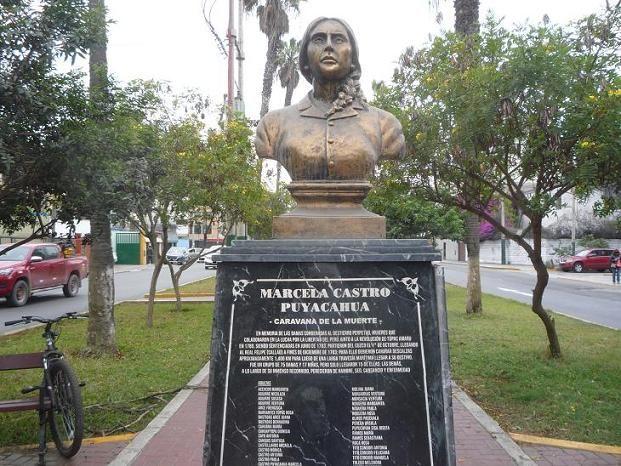
One of the memorials on the Boulevard de las Patricias along San Martín Avenue in Pueblo Libre, this one commemorating Marcela Castro Puyacahua, who served in the Tupac Amaru rebellion of 1780. The text refers to the “Caravan of Death,” a group of 92 prisoners, women and children, who were sent barefoot on a march from Cusco to Lima, which only fifteen would survive. Marcela Castro appears not to have been part of this march, but was executed separately in Lima (or Cusco; sources differ).
Scenes from Huaca Pucllana in Miraflores:
Scenes from the Mateo Salado Archaeological Complex:
In Pueblo Libre:
Scene on the Boulevard of Criollismo (i.e., Peruvian "Creole" music) -- not exactly a boulevard, but a short pedestrian street near the National Museum of Anthropology and Archaeology.
One of the memorials on the Boulevard de las Patricias along San Martín Avenue in Pueblo Libre, this one commemorating Marcela Castro Puyacahua, who served in the Tupac Amaru rebellion of 1780. The text refers to the “Caravan of Death,” a group of 92 prisoners, women and children, who were sent barefoot on a march from Cusco to Lima, which only fifteen would survive. Marcela Castro appears not to have been part of this march, but was executed separately in Lima (or Cusco; sources differ).
Looking forward to the rest of your report. I've been a fan of Lima for a decade, but haven't been back since the pandemic. Have never heard of the Mateo Salado site! (I once stayed in Pueblo Libre near the Plaza Vea).
I was an early user of taxidatum, to the point where the owner himself picked me up (I used it when it was possible to leave the airport on an international layover without paying the airport tax, those days are gone).
I was an early user of taxidatum, to the point where the owner himself picked me up (I used it when it was possible to leave the airport on an international layover without paying the airport tax, those days are gone).
Mlgb,
I hope you make it back to Lima soon. My most recent visit to Peru, prior to the one I'm discussing, had been in 2019 -- for me, five years without visiting Peru were getting to be a bit too much! And I've considered lodging in Pueblo Libre myself, though I haven't done so yet -- it's a rather nice area, with easy access to several of the sites I mentioned, as well as to two of Lima's premier museums. My only regret is that the blue line that was once painted along the streets and sidewalks to mark the walking route between those two museums (the Rafael Larco and the National Museum, as I'm sure you know), has faded badly, at least towards the National Museum end. Perhaps online map applications have made it obsolete.
I hope you make it back to Lima soon. My most recent visit to Peru, prior to the one I'm discussing, had been in 2019 -- for me, five years without visiting Peru were getting to be a bit too much! And I've considered lodging in Pueblo Libre myself, though I haven't done so yet -- it's a rather nice area, with easy access to several of the sites I mentioned, as well as to two of Lima's premier museums. My only regret is that the blue line that was once painted along the streets and sidewalks to mark the walking route between those two museums (the Rafael Larco and the National Museum, as I'm sure you know), has faded badly, at least towards the National Museum end. Perhaps online map applications have made it obsolete.
Related Topics
- Trip to Peru - Lima 1 day & Peru 2 days; 4D3N hike to MP
- Peru- Mountain Lodges of Peru vs Austin Lehman/time in Lima
- Trip Report: Lima/Sacred Valley/Cusco/Lima
- SharonNRayMc: Trip Report - 24 days on the road: Miami, Jupiter, Bolivia and Peru... and what some folks will do to see the Devil Dance! (Part 2)

