Novices and reluctant art enthusiasts are often awestruck by the masterpieces before them here, including Monet's Water Lilies, Picasso's Les Demoiselles d'Avignon, and van Gogh's Starry Night. The museum's somewhat recent $425 million face-lift by Yoshio Taniguchi increased exhibition space by nearly 50%, including space to accommodate large-scale contemporary installations. Its current building gave the museum an opportunity to shift focus from modern to contemporary art, evident in the recent creation of a media department. The museum continues to collect: most recently it obtained important works by Martin Kippenberger, David Wojnarowicz, Jasper Johns, Kara Walker, and Neo Rauch. One of the top research facilities in modern and contemporary art is housed inside the museum's eight-story "Education and Research" building.
Highlights
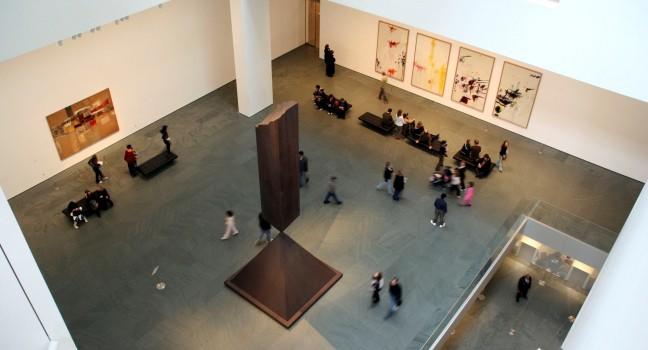
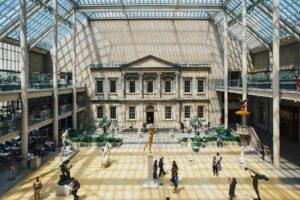
In addition to the artwork, one of the main draws of MoMA is the building itself. A maze of glass walkways permits art viewing from many angles.
The 110-foot atrium entrance (accessed from either 53rd or 54th Street) leads to the movie theater and the main floor restaurant, "Modern," with the Alsatian-inspired cuisine of Chef Gabriel Kreuther.
The museum has other worthy food options: Café 2 on the second floor serves rustic Italian cooking; Terrace 5, adjacent to the Painting and Sculpture Galleries, has sophisticated American food, specialty cocktails, and microbrewed beers along with spectacular views.
A favorite area in which to take a break is the Abby Aldrich Rockefeller Sculpture Garden. Designed by Philip Johnson, it features Barnett Newman's Broken Obelisk (1962-69). The glass wall lets visitors look directly into the surrounding galleries from the garden.
Contemporary art (1970 to the present) from the museum's six curatorial departments shares the second floor of the six-story building, and the skylighted top floor showcases an impressive lineup of changing exhibits.
Modern Art for the Masses
MoMA works hard to make modern art accessible and enjoyable, including a variety of audio tours for both adults and kids. You can grab a portable player free of charge at the museum, or download podcasts onto your own handheld device from the museum's Web site. Check out the free wireless service within the museum to listen to audio tours as you wander through MoMA (log onto www.moma.org/wifi with your HTML browser-enabled device).
Interactive kiosks in the museum help you navigate the massive space and let you relate works you've seen with those not on display.
Movies & the MoMA
With so much art on display, it's hard to remember that the MoMA has a movie theater. Film passes to the day's screenings are included with the price of admission. Film-only tickets are $10 and must be purchased in person at specific locations and times; check MoMA's Web site for details. Hang onto the ticket stub, the cost will be deducted from your admission fee if you return to the museum within 30 days.
Two for the Price of One
Tickets to MoMA include free admission to another museum—the avant-garde P.S. 1 in Queens. Don't worry; you won't need to trek out to Queen on the same day. Save your ticket and you can go in for free any time within 30 days of your original purchase. Also check MoMA's Web site (where you can prepurchase tickets) for special deals and packages that include admission to other NYC venues.
Tips
MoMA is a popular destination for locals and tourists, and that translates into lines that sometimes snake down the block. Weekdays tend to be less crowded. Come without bags or backpack to avoid the wait for the checkroom.
Consider lining up for the free audio guide, especially if the scribbled and rather ambiguous nature of modern art occasionally confounds you.
Entrance between 4 and 8 PM on Friday is free, but come expecting to wait in line.
Interview with Peter Reed, Senior Deputy Director for Curatorial Affairs, the Museum of Modern Art.
For visitors planning to see highlights of the collection, I recommend they begin in the Painting and Sculpture Galleries on the fifth floor. Here the stories of modern art unfold, from the late 19th century up to World War II. Renowned paintings such as Vincent van Gogh's Starry Night (1889), Pablo Picasso's Les Demoiselles d'Avignon (1907), Henri Matisse's Dance (1909), and Joan Miró's The Birth of the World (1925) are installed in the context of other extraordinary works. In the fourth-floor galleries I enjoy showing visitors the diverse works by abstract expressionists, such as Jackson Pollock's One (1950), a masterpiece of the "drip" technique.
To best understand the richness and complexity of MoMA's collection, try to visit the galleries devoted to contemporary art, architecture and design, drawings, photography, prints, media, as well as the international film program in the museum's Titus theaters.
Don't miss: One of my favorite places at MoMA is the Abby Aldrich Rockefeller Sculpture Garden, designed by Philip Johnson in 1953. The garden lies at the heart of the museum and is a spectacular urban oasis with its reflecting pools, seasonal plantings, and masterworks of modern sculpture.
Reviewed by bachslunch from US on 12/14/08
This is arguably the best modern art museum in the world, with no shortage of anthology level canvases and arguably the strongest quality to quantity ratio in a museum of this sort. Pleasant sculpture garden, too. The $20.00 cost is horribly expensive even under these circumstances, though, and it's not a "suggested" amount either. Still, go anyway -- it's the best of its kind there is.
Reviewed by gordeb from Ontario on 7/22/08
It was pouring rain when we slipped in. Started at the top and worked our way down. Brilliant!! Especially Monet.
Reviewed by LStern2900 from NY on 7/17/08
Fabulous collection,concerts on weekend evenings,great restaurant
Visit the Travel Talk forums for help on planning your trip