

Fodor's Expert Review Museo Nacional Centro de Arte Reina Sofía
Spain’s national museum of contemporary art houses works by all the major 20th-century Spanish painters and sculptors. Its collection breaks from tradition by grouping works of the great modern masters—Picasso, Miró, and Salvador Dalí—by historical context as opposed to artistic movement. So, Goya's Disasters of War engravings (a precursor of the avant-garde movements of the 20th century) sits beside one of the first movies ever made, Employees Leaving the Lumière Factory by the Lumière brothers. Picassos and Dalís are not displayed together but are rather scattered around the 38 rooms. The museum also displays important works by Juan Gris, Jorge Oteiza, Pablo Gargallo, Julio González, Eduardo Chillida, and Antoni Tàpies.
The crown jewel is Picasso's Guernica. The sprawling black-and-white canvas depicts the horror of the Nazi bombing of innocent civilians in the ancient Basque town of Gernika in 1937 during the Spanish Civil War. The work was... READ MORE
Spain’s national museum of contemporary art houses works by all the major 20th-century Spanish painters and sculptors. Its collection breaks from tradition by grouping works of the great modern masters—Picasso, Miró, and Salvador Dalí—by historical context as opposed to artistic movement. So, Goya's Disasters of War engravings (a precursor of the avant-garde movements of the 20th century) sits beside one of the first movies ever made, Employees Leaving the Lumière Factory by the Lumière brothers. Picassos and Dalís are not displayed together but are rather scattered around the 38 rooms. The museum also displays important works by Juan Gris, Jorge Oteiza, Pablo Gargallo, Julio González, Eduardo Chillida, and Antoni Tàpies.
The crown jewel is Picasso's Guernica. The sprawling black-and-white canvas depicts the horror of the Nazi bombing of innocent civilians in the ancient Basque town of Gernika in 1937 during the Spanish Civil War. The work was commissioned by the Republican government for the Spanish pavilion at the 1937 World's Fair in an attempt to garner sympathy for the Republican cause. Rooms adjacent to Guernica reconstruct the artistic significance of Spain's participation in the World's Fair with works by Miró, Josep Maria Sert, Alexander Calder, and others. Guernica did not reach Madrid until 1981, as Picasso had stipulated in his will that the painting return to Spain only after democracy was restored.
The fourth floor in the Sabatini Building is devoted to art created after World War II, and the Nouvel Annex displays paintings, sculptures, photos, videos, and installations from the last quarter of the 20th century.
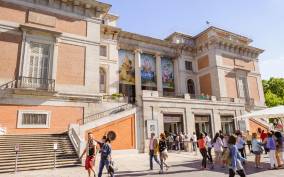
The museum was once a hospital, but the austerity of the space is somewhat relieved (or ruined, depending on your point of view) by the playful pair of glass elevator shafts on its facade. Three separate buildings joined by a common vault were added to the original complex in 2005—the first contains an art bookshop and a public library, the second a center for contemporary exhibitions, and the third an auditorium and restaurant. The latter, which got a face-lift in 2017, is a colorful, space-age spot to enjoy a café con leche—or a cocktail—and an eye-catching tapa or two.
READ LESS