

Fodor's Expert Review Santa Maria Gloriosa dei Frari
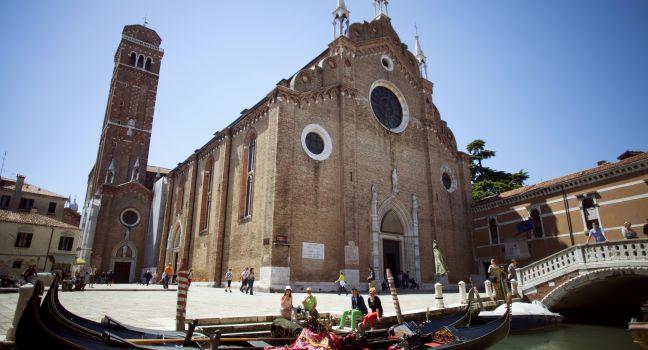
Completed in 1442, this immense Gothic church of russet-color brick, known locally as “I Frari,” is famous worldwide for its array of spectacular Venetian paintings and historic tombs. It is also noteworthy for being the only important church in Italy that has preserved its elaborately carved, freestanding wooden choir in front of the high altar, a common feature in the medieval period (for the use of the monks in the attached monastery, still active today).
Visit the sacristy first, to see Giovanni Bellini's 1488 triptych Madonna and Child with Saints in all its mellow luminosity, painted for precisely this spot. The Corner Chapel on the other side of the chancel is graced by Bartolomeo Vivarini's (1415–84) 1474 altarpiece St. Mark Enthroned and Saints John the Baptist, Jerome, Peter, and Nicholas, which is much more conservative, displaying an attention to detail generally associated with late medieval painting. In the first south chapel of the choir, there... READ MORE
Completed in 1442, this immense Gothic church of russet-color brick, known locally as “I Frari,” is famous worldwide for its array of spectacular Venetian paintings and historic tombs. It is also noteworthy for being the only important church in Italy that has preserved its elaborately carved, freestanding wooden choir in front of the high altar, a common feature in the medieval period (for the use of the monks in the attached monastery, still active today).
Visit the sacristy first, to see Giovanni Bellini's 1488 triptych Madonna and Child with Saints in all its mellow luminosity, painted for precisely this spot. The Corner Chapel on the other side of the chancel is graced by Bartolomeo Vivarini's (1415–84) 1474 altarpiece St. Mark Enthroned and Saints John the Baptist, Jerome, Peter, and Nicholas, which is much more conservative, displaying an attention to detail generally associated with late medieval painting. In the first south chapel of the choir, there is a fine sculpture of St. John the Baptist by Donatello, dated 1438 (perhaps created before the artist came to Venice), which conveys a psychological intensity rare for early Renaissance sculpture. You can see the rapid development of Venetian Renaissance painting by contrasting Bellini with the heroic energy of Titian's Assumption, over the main altar, painted only 30 years later. Unveiled in 1518, it was the artist's first public commission and, after causing a bit of controversy, did much to establish his reputation. Upon viewing this painting at the far end of the nave, you'll first think it has been specially spotlit: up close, however, you'll discover this impression is due to the painter's unrivaled use of light and color.
Titian's masterpiece, the Madonna di Ca' Pesaro, is in the left aisle. The painting took seven years to complete (finished in 1526), and in it Titian disregarded the conventions of his time by moving the Virgin out of center and making the saints active participants. The composition, built on diagonals, anticipates structural principals of Baroque painting in the following century. The work is brought to life by the unconventional gaze of young Leonardo Pesaro, who seems to look directly at the viewer.
The Frari also holds a Sansovino sculpture of St. John the Baptist and Longhena's impressive Baroque tomb designed for Doge Giovanni Pesaro. Titian, who died during the plague of 1576, is buried near his luminous Madonna di Ca' Pesaro; the massive marble monument to him near the main entrance was commissioned by the emperor of Austria in 1838 in recognition of the artist who had worked at the court of his forefathers. The black marble tomb of musician Claudio Monteverdi, one of the greatest composers of the 17th century, is in the chapel of the Milanese to the left of the high altar. There are always roses lying on it, left by anonymous admirers.
READ LESS