Constructed to honor all pagan gods, this best preserved temple of ancient Rome was rebuilt in the 2nd century AD by Emperor Hadrian, and to him much of the credit is due for the perfect dimensions: 141 feet high by 141 feet wide, with a vast dome that was the largest ever designed until the 20th century.
Though its population numbers only in the few hundreds, the Vatican—home base for the Catholic Church and the pope—makes up for them with the millions who visit each year. Embraced by the arms of the colonnades of St. Peter's Square, they attend Papal Mass, marvel at St. Peter's Basilica, and savor Michelangelo's Sistine Ceiling.
Legend has it that as long as the Colosseum stands, Rome will stand; and when Rome falls, so will the world. One of the seven wonders of the world, the mammoth amphitheater was begun by Emperor Vespasian and inaugurated by Titus in the year 80. For "the grandeur that was Rome," this obstinate oval can't be topped.
You couldn't concoct a more Roman street scene: caffès and crowded tables at street level, coral- and rust-colored houses above, most lined with wrought-iron balconies, and, at the center of this urban "living room," Bernini's spectacular Fountain of the Four Rivers and Borromini's super-theatrical Sant'Agnese.
This fabled labyrinth of ruins variously served as a political playground, a commerce mart, and a place where justice was dispensed during the days of the emperors (500 BC to 400 AD). Today, the Forum is a silent ruin—sic transit gloria mundi (so passes away the glory of the world).
Catch a bird's-eye view of the Roman Forum from Michelangelo's piazza, situated atop one of the highest spots in Rome, the Capitoline Hill. Here you'll find the Capitoline Museums and beloved Santa Maria in Aracoeli.
One of the few fountains in Rome that's actually more absorbing than the people crowding around it, the Fontana di Trevi was designed by Nicola Salvi in 1732. Immortalized in Three Coins in the Fountain and La Dolce Vita, this granddaddy of all fountains may be your ticket back to Rome—that is, if you throw a coin into it.
Byron, Shelley, and Keats all drew inspiration from this magnificent "Scalinata," constructed in 1723. Connecting the ritzy shops at the bottom with the ritzy hotels at the top, this is the place for prime people-watching. The steps face west, so sunsets offer great photo-ops.
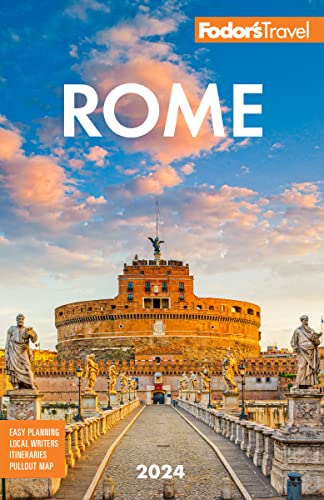
Originally constructed as a mausoleum for Roman emperor Hadrian, this cylindrical building, which towers over the city's skyline, alternately served as a fortress, a castle, and papal prison.
Located just across the Tiber River, this time-stained, charming neighborhood is a maze of jumbled alleyways, traditional Roman trattorie, cobblestone streets, and medieval houses. The area also boasts the oldest church of Rome—Santa Maria in Trastevere.
None other than the great Michelangelo would suffice to design the master plan for Rome's own collection of art and archaeological museums, which enticingly crown the Capitoline Hill. The museum is divided into two wings: Palazzo Nuovo, devoted to ancient sculpture, and the Palazzo dei Conservatori, with great Old Masters.
Waltzing through this 17th-century palace may be the closest you ever get to the aristocratic nobles. Fabled Old Master paintings line the walls, with pride of place going to Velàzquez's Innocent X (the family pope), perhaps the greatest portrait ever painted.
Catch a glimpse of exquisite taste in this 15th-century palace, once owned by Cardinal Altemps and today part of the Museo Nazionale Romano—on view are many legendary examples of classic Greek and Roman sculpture, including the "Ludovisi Throne."
Only the best could only satisfy the aesthetic taste of Cardinal Scipione Borghese, whose holdings evoke the essence of Baroque Rome. Spectacularly frescoed ceilings and multihued marble walls frame great Bernini sculptures and paintings by Titian and Raphael.
During the 18th century, the Spanish Steps became a gathering place for Grand Tour artists and writers, so here in 1821 the English Romantic poet John Keats came to write—and ultimately die (of tuberculosis)—in the Casina Rossa, a dusty pink house at the base of the steps.
The city's own great collections of ancient Roman sculpture, paintings, and precious relics—salvaged from excavations completed over several centuries—is so vast that four separate museums at different locations are needed: Palazzo Altemps, Aula Ottagona, Terme di Diocleziano, and Palazzo Massimo alle Terme.
Lifestyles of the Rich and Famous, Renaissance-era version, are on display at this extravagant villa, built around 1511 by banker Agostino Chigi, with loggias decorated by Raphael. After lavish dinners, Chigi would toss his gold plates into the Tiber and slyly retrieve them with a net in the water.
The seemingly endless line waiting for entry here can be intimidating, but the reward—a vast collection of masterpieces, including the Raphael Rooms—make it worth it. The agony, not the ecstasy, of it all is summed up in Michelangelo's sublime Last Judgment and Sistine ceiling.
The three fathers of the Baroque—Bernini, Borromini, and Pietro da Cortona—whipped up this imposing 17th-century palace for the Croesus-rich Barberini family. Built around 1625, with the Gran Salone, Rome's largest ballroom, the palazzo is now home to the city's collection of Old Master paintings.
A glorious 17th-century assemblage of stuccowork and statuary, together with the impressive trompe l'oeil "trick" of its courtyard colonnade, inspired by master designer Borromini, is what draws the crowds.
Every year, millions of pilgrims flock to the world's most important Catholic church, as art lovers marvel at Michelangelo's cupola, Bernini's papal altar, and the vast nave. The burial site of its namesake, St. Peter's took such Italian masterminds as Raphael and Bramante more than a century to complete.
Even locals can't help being mesmerized by the splendors of this church's piazza, chief among them being the incandescent Byzantine mosaics on the basilica's facade and the elegant octagonal fountain. Inside, the vast nave stupefies with its gigantic Roman columns and glittering golden mosaics.
Studying the dome up high in this fantastically bejeweled 1626 Jesuit church, you may think your eyes are playing tricks on you. But it's not your eyes! That extraordinarily accurate replica of a Baroque dome was painted in its place after plans for the cupola fell through.
Prominently positioned in Piazza Navona, this church has some of Rome's most quintessential Baroque architecture. Designed by Borromini (1652), a fervent rival of Bernini's, the church's facade is a stunning symphony of voluminous concave spaces and bell towers.
Moody, medieval, and magnificent, this 12th-century Romanesque church draws throngs to its portico where the stone Bocca della Verità (Mouth of Truth) sits in judgment—dare you test the legend that its stone jaws clamp shut on the hands of the untruthful?
Uncover the layers of Medieval Rome here at this half-basilica, half archaeological site. Famed for its mosaics, this 12th-century church actually sits on top of another church that dates back to the 4th century and a 2nd-century BC temple to the pagan god, Mithras.
Few other churches in Rome reflect the richness of Renaissance art as does Santa Maria del Popolo, thanks to its nave enlarged by Bramante and the Chigi Chapel, a Raphael masterwork. But equally striking are Baroque treasures like Caravaggio's Cerasi Chapel and Bernini's mosaic-covered dome.
Set on a piazza graced by Bernini's famed elephant obelisk, this Gothic-style church—best known for Michelangelo's Risen Christ and famed frescoes by Filippino Lippi—gives off a heavenly aura, thanks to arched blue ceilings ashimmer with gold stars.
Set on the Capitoline Hill and atop a towering, 137-step stairway (designed in 1348 to celebrate the passing of the Black Death), this Romanesque-Gothic landmark was begun in the 6th century and is home to the famed Santo Bambino, a carved-wood Baby Jesus figure.
It's hard to miss the 15 gargantuan marble statues (including Christ and the 12 Apostles) that tower over the facade of Rome's official cathedral and first church of the popes. The Baroque interior was accomplished by Borromini, but many pilgrims head first to the legendary Scala Santa (Holy Steps).