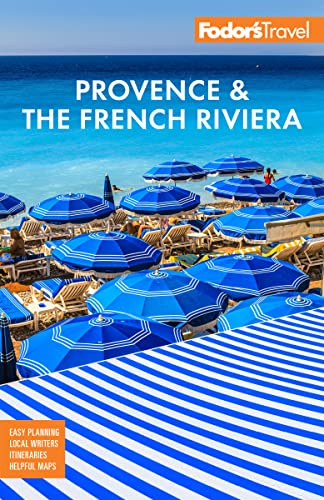
With their worldwide fame as the earth's most glamorous beaches, the real thing often comes as a shock to first-timers: much of the Côte d'Azur is lined with rock and pebble, and the beaches are narrow swaths backed by city streets or roaring highways. Only St-Tropez, Cannes, and isolated bits around Fréjus and Antibes have sandy waterfronts, hence their legendary popularity. Many beaches are privately operated, renting parasols and mattresses to anyone who pays; if you're a guest at one of the local hotels, you'll get a discount. Fees for private beaches average EUR 6-EUR 10 for a dressing room and mattress, between EUR 2 and EUR 4 for a parasol, and between EUR 4 and EUR 5 for a cabana to call your own. Private beaches alternate with open stretches of public frontage.
The best plages (beaches) are scattered along a 5-km (3-mi) stretch reached by the Route des Plages (Beach Road); the most fashionable are Moorea and Club 55; the most daring is the mostly topless Tahiti. Those beaches close to town—Plage des Greniers and the Bouillabaisse —are accessible on foot, but many prefer the 10-km (6-mi) sandy crescent at Les Salins and the long, sandy stretch of the Plage de Pampelonne, 4 km (3 mi) from town. Bicycles are an ideal way to get to the beach, and Espace 83 (2 av. Général-Leclerc. 04-94-55-80-00) is a popular place for rentals. Holiday Bikes (14 av. Général-Leclerc. 04-94-97-09-39) offers a wide variety of bikes for hire.
You may be put off by the heavily built-up waterfront bristling with parking-garage-style apartments and hotels, and its position directly on the waterfront highway, but Ste-Maxime is an affordable family resort with fine sandy beaches. It even has a sliver of car-free Vieille Ville and a stand of majestic plane trees sheltering central place Victor-Hugo. The main beach, north of town, is the wide and sandy La Nartelle.
Most of the beaches along La Croisette are owned by hotels and/or restaurants, though this doesn't necessarily mean the hotels or restaurants front the beach. It does mean they own a patch of beachfront bearing their name, where they rent out chaise longues, mats, and umbrellas to the public and hotel guests (who also have to pay). Public beaches are between the color-coordinated private beach umbrellas and offer simple open showers and basic toilets. Sailboats can be rented at either port or with some of the beachfront hotels.
Antibes and Juan together claim 25 km (15½ mi) of coastline and 48 beaches (including Cap d'Antibes). In Antibes you can choose between small sandy inlets—such as La Gravette, below the port; the central place de Ponteil; and Plage de la Salis, toward the Cap—rocky escarpments around the Vieille Ville; or the vast stretch of sand above the Fort Carré.
If Antibes is the elderly, historic parent, then Juan-les-Pins is the jazzy younger-sister resort town that, with Antibes, bracelets the wrist of the Cap d'Antibes. The scene along Juan's waterfront is something to behold, with thousands of international sunseekers flowing up and down the promenade or lying flank to flank on its endless stretch of sand. The Plage de Juan-les-Pins is made up of sand, not pebbles, and ranks among the Riviera's best (rent a beach chair from the nearby hotel concessions, the best of which is Les Belles Rives).
Nice's beaches extend all along the Baie des Anges, backed full-length by the Promenade des Anglais. Public stretches alternate with posh private beaches that have restaurants—and bar service, mattresses and parasols, waterskiing, parasailing, windsurfing, and jet-skiing. One of the handiest private beaches is the Beau Rivage (04-92-47-82-82), set across from the Opera. The sun can also be yours for the basking at Ruhl (04-93-87-09-70), across from the casino.